
Sixteen major contracts worth nearly $14 billion to be renewed by June 2018 but uncertainty looms large.

Even as Srini Pallia, a Wipro veteran, is set to take charge as the chief executive officer (CEO) of the company, analysts expect the stock's underperformance to continue in the near-future. This, they believe, will be on the back of likely loss of market share, and difficult business environment. "We expect Wipro to underperform peers on growth once again in FY25 as channel checks and media reports suggest Wipro is losing share with select clients across multiple verticals.

Equity investors became richer by over Rs 5.77 lakh crore on Tuesday, helped by a rally in the broader market where the BSE benchmark jumped nearly 2 per cent. The BSE Sensex zoomed 934.23 points or 1.81 per cent to settle at 52,532.07. Driven by the rally in equities, the market capitalisation of BSE-listed firms jumped by Rs 5,77,006.83 crore to stand at Rs 2,40,63,930.50 crore. "Absence of fresh selling triggers in the domestic and global economy along with falling commodity prices relieved the heavily discounted equity market to showcase recovery.

Among the Sensex firms, Bajaj Finserv, Tata Motors, Asian Paints, ITC, IndusInd Bank, State Bank of India, Tata Steel, Wipro, Infosys and Maruti were the major gainers. Tech Mahindra, HCL Technologies, Kotak Mahindra Bank, Titan and Larsen & Toubro were the major laggards.

Seven consecutive sessions of decline in the equity market has eroded the wealth of investors by a whopping Rs 10.42 lakh crore and the benchmark Sensex has tumbled more than 2,000 points during this period. Concerns over more rate hikes by developed economies, weak global equity markets and fresh foreign fund outflows from the domestic market have dented investor sentiments. On Monday, the BSE Sensex dropped 175.58 points or 0.30 per cent to end at 59,288.35 points, marking a decline for seven straight trading sessions.

In a major relief to Indian information technology (IT) companies operating in Australia, Canberra has agreed to amend its domestic laws to stop taxing offshore income of such Indian companies, as part of the free trade deal inked. This may lead to savings up to $200 million each year for over 100 Indian IT companies operating in Australia. "The Government of Australia has agreed to amend the domestic taxation law to stop the taxation of offshore income of Indian firms providing technical services to Australia. "This will resolve the issue that the Indian government has raised about the double taxation avoidance agreement (DTAA) between the two governments for the avoidance of double taxation and the prevention of fiscal evasion with respect to taxes on income," said a commerce ministry official.

This is expected to benefit subcontractor firms such as Manpower Group, Randstad, Adecco, Kelly Services, Allegis Global Solutions and a host of other boutique staffing firms which supply skilled manpower to technology companies in the US.

Among the Sensex firms, HCL Technologies fell the most by 2.4 per cent. IndusInd Bank (2.35 per cent), Infosys (2.28 per cent), Wipro (1.8 per cent), NTPC (1.71 per cent), Asian Paints (1.7 per cent), Tata Consultancy Services (1.36 per cent),Tech Mahindra (1.03 per cent) and SBI (1 per cent) were among the major laggards.

From the 30-share pack, Indusind Bank, Axis Bank, Maruti Suzuki, Bajaj Finance, Bajaj Finserv, UltraTech Cement and Mahindra & Mahindra were the biggest drags, tumbling up to 7.63 per cent.
Where do Indian IT firms stand compared to their global peers in this journey of transformation? Ayan Pramanik seeks answers from IT services analyst Phil Fersht.
Kotak Mahindra Bank was the biggest loser from the Sensex pack, skidding 1.83 per cent, followed by Axis Bank, NTPC, Hindustan Unilever, ICICI Bank, Bharti Airtel, Reliance Industries, HCL Technologies, IndusInd Bank and Nestle. In contrast, Bajaj Finance, Bajaj Finserv, Tech Mahindra, Tata Consultancy Services, Titan, Infosys, HDFC Bank, HDFC and ITC were the gainers.

Overlooked yet capable candidates will now have the opportunity to apply for TCS open requirements.

TCS, Infosys do well but Wipro & HCL disappoint analysts; however, outlook for FY17 bullish in general.

'It is not that the H1B visa employees are coming in to displace jobs.'

Investors will look at how TCS has performed when it announces the quarter's results on October 13, and the forecast from Infosys on October 14

'We are anticipating that the hiring trend will continue to see double-digit growth at least for the current financial year.'

Analysts are of the opinion that 55 may emerge as the new age to retire for techies in India
The analyst community tracking the Indian IT services industry took special note of Accenture's first quarter (Q1) performance, which showcased the rapid growth of its consulting business that outperformed its outsourcing business. Bookings indicate that the trend will continue. Consulting bookings increased 41.6 per cent year-on-year (yoy) to $9.4 billion, higher than the 17.6 per cent growth in outsourcing to $7.4 billion. The management commentary was also more bullish on the consulting business.

Infosys, Wipro may follow suit as investors eye a piece of the large cash kitty as growth slows.

The record in net addition from the top four was in 2016-17, of 59,427 employees.

Building front-end and stitching it with back-end is a task that IT firms are learning the hard way, finds Raghu Krishnan.

The board expansion comes against the backdrop of an ongoing tussle between the founders and the management over contentious issues such as CEO salary hike, severance package to former employees and corporate governance standards.

According to analysts, IT firms like Infosys, TCS and HCL Technologies are likely to benefit the most on account of larger US exposures and dollar billing.

Morgan Stanley's Asia and Global Emerging Markets Strategy Report downgraded software firms on valuation and earnings concerns.

Benchmark equity indices Sensex and Nifty closed higher on Friday after two days of fall, helped by buying in metal, telecom and auto stocks amid a firm trend in global markets. Automakers led by Maruti Suzuki India, Hyundai, Mahindra & Mahindra reporting robust wholesales of passenger vehicles and GST collections crossing Rs 1.50 lakh crore for the third straight month in May also added to the optimism. The 30-share BSE Sensex climbed 118.57 points or 0.19 per cent to settle at 62,547.11.
Equity indices overcame a wobbly start to clock gains for the third session on the trot on Tuesday, propped up by banking, metal and energy stocks amid a mixed trend in global markets. A recovery in the rupee also bolstered sentiment, traders said. The 30-share BSE Sensex advanced 246.47 points or 0.45 per cent to settle at 54,767.62 after starting the trade on a weak note. In a volatile session, the benchmark hit a high of 54,817.52 and a low of 54,232.82 during the day.

There are no major announcements in the Union Budget 2014-15.
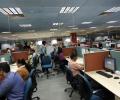
5,565 contracts, valued at $201 billion are up for rebids across geographies and verticals by 2018.

ITC was the biggest gainer in the Sensex pack, rising nearly 3 per cent, followed by Kotak Mahindra Bank, ICICI Bank, Maruti, Bharti Airtel, State Bank of India, Sun Pharmaceutical Industries, Axis Bank, Reliance Industries, Hindustan Unilever and JSW Steel. On the other hand, Infosys, UltraTech Cement, HCL Technologies, Bajaj Finserv, Larsen & Toubro, Titan, Tata Consultancy Services and Wipro were the laggards.

AI, cloud computing, data analytics are a few areas companies are looking for proficiency in

TCS is setting up a large BPO operation in Varanasi next year, some staff could be absorbed there

Fourth quarter earnings of blue-chips such as Infosys, TCS, Wipro, RIL and inflation data for March will dictate the trend on the bourses in a holiday-shortened week ahead, experts said.

From the Sensex pack, NTPC, Tata Motors, Titan, Larsen & Toubro, Reliance Industries, IndusInd Bank, Infosys, HDFC Bank and Power Grid were among the major gainers. Wipro and Tech Mahindra were the laggards.

According to Nasscom, engineering services exports had grown at 13 per cent in 2017 compared to six per cent rise in IT services exports and eight per cent in business process management (BPM). It had also recorded the highest growth in the last three years, reports Debasis Mohapatra.

Equity indices chalked up losses for the second straight session on Monday, in tandem with a bearish trend overseas as ratcheting up of hostilities in Ukraine and prospects of further rate hikes by the US Fed soured global risk sentiment. The rupee slipping to another all-time low against the US dollar amid foreign fund outflows added to the gloom, traders said. After tumbling over 800 points in intra-day trade, the 30-share BSE Sensex clawed back some lost ground to end 200.18 points or 0.34 per cent lower at 57,991.11.

Strong macroeconomic headwinds causing turbulence in the $245-billion Indian IT industry are yet to calm down. Top Indian IT services companies are likely to post a decline or just marginal growth in sequential revenue in Q1FY24 because of a soft discretionary spending environment. Though the first quarter is seasonally strong for IT firms, "June 2023 will be an exception", according to analysts at Kotak Institutional Equities.

Faced with a spate of senior-level exits, Infosys co-founder N R Narayana Murthy has written to employees to reassure them that the "leadership changes" will be in the "best interest" of the company.

The strategy of returning cash to shareholders through stock purchases could hinder their digital expansion plans

The catchwords today are digital, analytics, robotics.
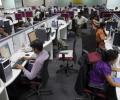
JP Morgan has downgraded the Indian information technology sector to 'underweight' as it believes the heydays of the sector are over. Rising margin headwinds in the near-term and the revenue headwinds in the medium-term from a potential macro slowdown, Ankur Rudra and Bhavik Mehta of JP Morgan said in the report, will mean that the sector's earnings upgrade cycle is behind. "We see peak revenue growth behind us and earnings before interest and taxes (EBIT) margins trending down from inflation, mean revision.
